
Ask this question on any RV forum and you will get an answer within the hour. It will not be a gentle one.
You will hear that covers scratch paint. That they shred in the first windstorm. That a dealer told someone to skip it. You will find long threads titled "RV Covers, Yes or No?" where the consensus lands firmly on no, and owners describe their experience with covers as an expensive mistake they would not repeat.
We sell RV covers. So you would expect us to tell you all of that is nonsense.
It is not nonsense. Most of it is accurate. A poorly built or poorly fitted cover absolutely can damage your RV, and the owners warning you about it are describing something real that happened to them.
What almost nobody explains is the mechanism. Once you understand how a cover causes damage, you can tell in about thirty seconds whether a given cover is going to protect your RV or slowly grind the finish off it. That is worth more than any brand recommendation, including ours.
Here is the honest version.
Billowing is the whole problem
A cover that does not sit tight catches wind like a sail. Every gust lifts it and drops it, and the fabric moves across your sidewalls hundreds of thousands of times over a winter. Add the dust that inevitably works its way underneath, and you have built a very slow, very patient sanding machine.
This is why experienced owners insist you only cover a freshly washed RV. They learned it the hard way. Trapped grit under a moving cover does the damage, not the fabric itself.
The failure is not the material. It is tension. A cover that cannot be pulled tight and held tight will move, and movement is what causes wear.
Everything else follows from it
Wear points. Covers rarely fail mid panel. They fail where something presses into the fabric from underneath: the top of the rear ladder, gutter kick-outs, the AC shroud, the antenna, sharp front corners. This is why owners tape pool noodles and bubble wrap over their own RVs before installing a cover. They are patching a design gap in the cover they bought. Once the fabric opens at one of those points, the tear spreads, the cover loosens, and now you have a torn cover and an untensioned one flapping against your paint.
Trapped moisture. A cover that blocks water but does not release vapour is worse than no cover. You get mould growing against your sidewalls all winter and black streaking that is genuinely hard to remove. "Waterproof" on its own is not a good sign. You want water shed from above and vapour released from below.
Installation. Dragging a heavy cover across vents and AC units tears it before it has seen a day of weather. In light wind, a large cover behaves like a sail while you are standing on a ladder holding it. Plenty of owners bought a cover, failed to get it on once, and left it in the garage permanently.
So should you skip the cover?
This is where the forum consensus overcorrects.
Uncovered storage has its own bill, it just arrives more slowly. UV chalks your gel coat and cracks your decals. Roof sealant degrades, and sealant failure is how water gets into the walls, which is a five figure problem. Then there is the staining, and the birds nesting in your AC shroud.
If you have indoor storage or a carport, use it. It beats any cover on the market. If your RV sits outside for six months a year, the real choice is not cover versus no cover. It is a cover that holds tension versus one that does not.
What to actually ask before you buy
Skip the marketing copy about UV protection. Every cover claims it. Ask instead:
- How does this hold tension against the sidewalls, not just underneath?
- Are stress points reinforced, and are the ladder, gutters and tires covered?
- Can moisture get out?
- Can one person install it without climbing on the roof or crawling under the rig?
- Does the size range match my real measurements, not my RV's brochure length?
That last one matters more than people expect. A cover that is too large cannot be cinched tight enough to stop billowing, which puts you straight back at problem one.
How KNOX is built
We designed our covers against this exact list, because it is the same list RV owners have been repeating to each other for twenty years.
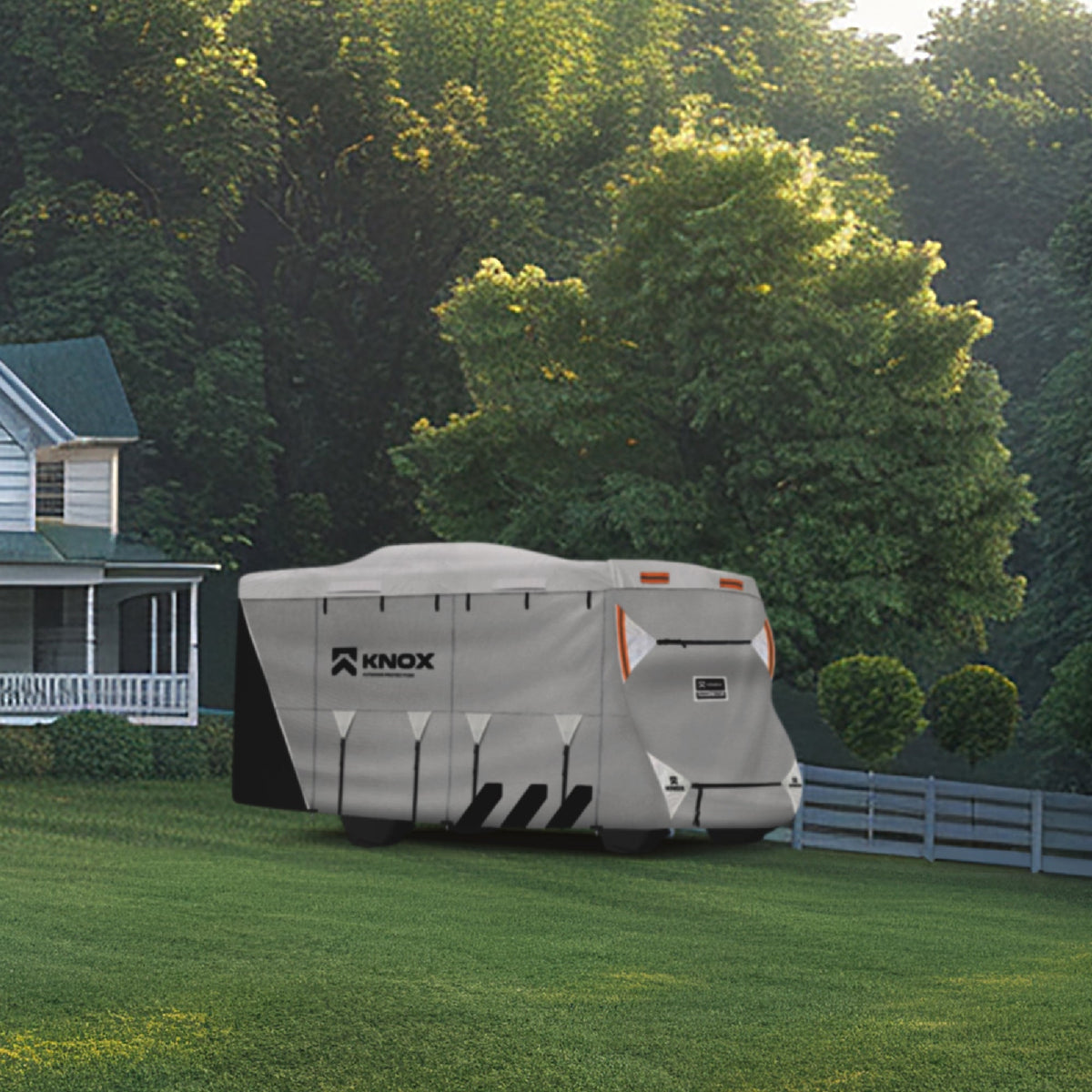
Raised side tension straps pull the cover flat against the sidewalls instead of just gathering it underneath, which addresses abrasion at the source. Stress points are reinforced throughout, with a ripstop elastic hem at the bottom edge. The ladder cover, gutter covers, tire covers and propane cover ship in the box, because those are the exact places owners currently protect with tape and pool noodles. Vents on both sides let moisture escape. A weighted throw system sends the straps under the RV so you do not have to, and most owners have the cover on in under twenty minutes working alone. Rollable zippered doors let you get inside through the winter without pulling the whole cover off.
We are the more expensive option here and we will not pretend otherwise. The comparison worth making is not our price against a budget cover, but against a shredded cover plus a corrected paint finish.
Share:
Why Smart Boat Owners Invest in Shade First
Fall RV Storage Checklist for Canadian Winters